Stepping into an arcade in 1982, you weren't just playing a game; you were entering a digital universe. The whirring sounds, the glowing lines, the unmistakable hum of the Master Control Program – this was the immersive promise of Tron, the arcade sensation that captured imaginations just as its namesake film hit theaters. More than just a tie-in, the history and development of the Tron arcade game is a fascinating tale of rushed deadlines, innovative design, and a cultural impact that reverberates through digital entertainment even today.
At a Glance: The Tron Arcade Phenomenon
- Inspired by the Silver Screen: Directly tied to Disney's groundbreaking 1982 film, developed and published by Bally Midway.
- Rapid-Fire Development: Conceived and brought to market in a mere six-month window, accelerating to just four months from prototype to production.
- Four Games in One: Unique multi-stage gameplay featuring distinct sub-games: Light Cycles, I/O Tower, Battle Tanks, and MCP Cone.
- Iconic Aesthetic: Defined by its glowing neon lines, digital landscapes, and immersive cabinet design, directly mimicking the film's visual style.
- Commercial Juggernaut: Outgrossed the film it was based on, generating over $45 million by 1983 (equivalent to over $140 million today).
- Enduring Legacy: Pioneered multi-game structures, influenced cyberpunk aesthetics, and remains a competitive classic with an active community.
The Digital Frontier Beckons: Birth of a Grid-Defining Game
The year 1982 was a watershed moment for digital entertainment. Walt Disney Productions pushed boundaries with Tron, a film that took audiences inside a computer. Naturally, the world of arcade games, then experiencing its golden age, was ripe for a digital adaptation. Bally Midway stepped up to the plate, securing the coveted licensing rights from Disney, setting the stage for what would become one of the most memorable coin-op experiences of its era.
Development for the Tron arcade game was a true sprint. Kicking off in late 1981, the team was given an ambitious six-month timeline, which quickly intensified into a breakneck four-month window from initial prototype to full production. This tight schedule was critical to align with the film's August 1982 promotional push and theatrical release, ensuring the game capitalized on the movie's buzz. The core team included programmer Bill Adams, project manager George Gomez, art director Paul Farris, hardware engineer Atish Ghosh, and sound programmer Earl Vickers, all working under immense pressure to deliver a groundbreaking experience.
Early concepts for the game included an ambitious 3D vector-based approach, which might have pushed graphical boundaries even further. However, due to the extreme time constraints and technical complexities of such a system, this proposal was ultimately rejected. The team pivoted to a raster graphics approach, which proved more feasible. This shift allowed them to focus on expertly mimicking the film's distinctive neon aesthetics, a decision that would become a defining characteristic of the game's immersive appeal. Even film director Steven Lisberger provided input, ensuring the game stayed true to the movie's vision, with Disney Productions holding final approval over all visual assets.
Stepping into the Machine: Tron's Iconic Cabinet and Controls
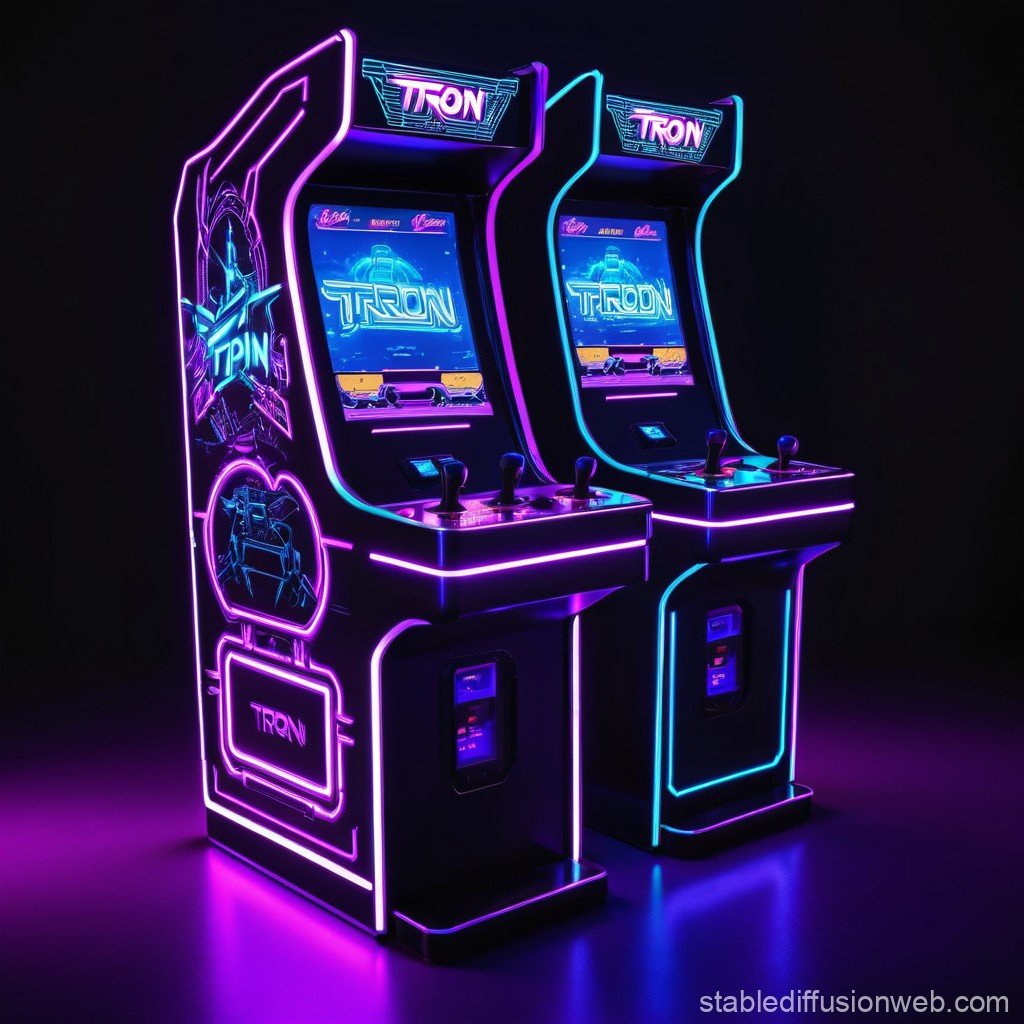
Part of the Tron arcade game's magic lay in its physical presence. The upright cabinet wasn't just a box; it was a portal. Weighing in at approximately 304 pounds, its distinctive design immediately caught the eye. Thematic artwork depicting circuit-like patterns adorned its sides, hinting at the digital world within. What truly made it stand out, however, was its innovative use of blacklight illumination. This bathed the translucent blue joysticks and glowing control panels in an ethereal glow, making the game feel even more otherworldly and true to the film's aesthetic. Some arcade installations even upped the ante with an additional spectator screen, drawing crowds and adding to the communal arcade experience.
Bally Midway understood the importance of accessibility, producing the game in various cabinet forms to suit different arcade layouts. While the upright cabinet was the most common and visually striking, cocktail versions (where players sit around a table-like unit) and cabaret/mini variants also allowed operators to bring the Game Grid to a wider audience.
The game's control scheme was meticulously designed to manage its diverse sub-games. Players navigated Tron through the digital realm using an intuitive eight-way joystick, which often featured a built-in trigger button for specific actions. Complementing this was a crucial rotary spinner knob, essential for precise aiming and maneuvering in certain segments. This combination of controls was pivotal, allowing players to feel fully immersed whether they were steering a Light Cycle or targeting the MCP's defenses.
Decoding the Game Grid: Gameplay Mechanics and Sub-Games Unpacked
At its heart, Tron offered a pioneering multi-game structure, presenting players with a randomized selection of four distinct sub-games within each level. The primary objective was straightforward: guide the protagonist, Tron, through these digital challenges, accumulate points, and dismantle the tyrannical Master Control Program (MCP).
Players began their journey with a default of three lives, though arcade operators could configure this setting via dip switches, allowing anywhere from one to nine lives. An extra life was typically awarded upon reaching point thresholds, such as 10,000 points, offering a tangible reward for skilled play. The game progressed through 12 escalating difficulty levels, imaginatively named from "RPG" all the way to "USER." Each sub-game typically imposed a time limit, usually between 30 to 60 seconds, adding a layer of urgency and strategic planning to every challenge.
Let's break down the four iconic sub-games that defined the Tron experience:
Light Cycles
This is arguably the most famous segment, directly inspired by the film's iconic chase sequences. Players pilot a light cycle, leaving a solid, colored trail behind them. The goal is to strategically maneuver, drawing barriers to trap AI opponents, forcing them to crash into your trail or the arena walls. The key challenge? You cannot stop or reverse your light cycle, demanding constant forward motion and quick thinking to outsmart your digital adversaries. Success in Light Cycles often felt like a chess match at lightning speed.
I/O Tower
Transitioning to a top-down perspective, the I/O Tower segment tasked Tron with a delicate mission. Players used their disc weapon to either destroy or deftly avoid multiplying Grid Bugs, navigating a complex grid. The ultimate goal was to reach a central, flashing I/O Tower entrance within a time limit, typically around 35 seconds. This segment demanded precise movement and efficient target prioritization, as Grid Bugs could quickly overwhelm an uncoordinated player. Any remaining time upon entering the tower was converted into a bonus score, adding to the pressure.
Battle Tanks
This sub-game plunged players into top-down tank combat within a maze-like grid. Here, Tron controls a tank, tasked with destroying enemy vehicles, which included smaller tanks and the formidable Recognizers, all while evading their retaliatory fire. The maze layout, combined with the movement patterns of enemy units, made Battle Tanks a test of both offensive power and defensive maneuvering. Hits on enemy tanks earned varied points (100, 300, or 500, depending on the target or hit accuracy), rewarding strategic engagement.
MCP Cone
The MCP Cone segment offered a visually striking pseudo-3D experience, drawing players deeper into the heart of the Master Control Program. The objective was to target and destroy rotating, descending blocks that formed a shield wall around the MCP cone entrance. Using their disc, players had to clear a path through these defenses within a strict time limit to enter the cone. This sequence often felt like a desperate final assault, requiring quick reflexes and accurate aiming to breach the MCP's formidable defenses.
Scoring in Tron was designed to reward skill and progression. Each defeated Grid Bug earned 50 points, while taking out a Light Cycle awarded a significant 500 points. Collecting a rare "Bit" yielded a hefty 5,000 points, and successfully clearing an MCP Cone entrance granted a generous 1,000 points. These varied point allocations kept players engaged and strategizing which threats to prioritize, all contributing to the race for high scores on the leaderboard.
Beyond the Pixels: Tron's Commercial Triumph and Cultural Footprint
The anticipation surrounding the Tron arcade game paid off handsomely. Following promotional tournaments in June and a U.S. debut in July, the game enjoyed its full commercial release in August 1982. Its success was immediate and profound. Bally Midway distributed approximately 10,000 cabinets to arcades across North America, a testament to its widespread appeal.
Financially, Tron was nothing short of a phenomenon. By 1983, it had generated an estimated $45 million in revenue, a figure that, when adjusted for inflation, would be approximately $140 million in 2023 dollars. This staggering success meant the arcade game alone surpassed the film's worldwide box office gross of $33 million, a rare feat for a licensed title. Its popularity was evident in industry charts; by January 1983, RePlay magazine ranked Tron as the fourth highest-grossing arcade game.
Marketing played a crucial role in Tron's triumph. Bally Midway leveraged a powerful "play the movie" theme, perfectly aligning the game with the film's groundbreaking visual style. This was supported by a million-dollar radio promotion campaign and even demo units strategically placed at Disneyland, allowing potential players to experience the Game Grid firsthand in a high-profile setting.
Critics and players alike lauded Tron. Electronic Games magazine honored it with the prestigious "Coin-Operated Game of the Year" award. On MobyGames, it still holds an impressive 85% aggregate user score. Reviewers consistently praised its innovative multi-game structure, which kept gameplay fresh and engaging, and its truly immersive experience. The faithful recreation of the film's neon aesthetic was a particular highlight, making players feel like they were genuinely inside the computer world. While some critics noted abrupt difficulty spikes, these minor quibbles did little to detract from the game's overall appeal and groundbreaking nature.
The Enduring Legacy: From Arcade to Modern Reboots
Tron wasn't just a hit; it was a blueprint. Its innovative multi-stage gameplay, seamlessly transitioning between distinct challenges, influenced countless later arcade titles and game designers. It demonstrated that a single game could offer varied experiences under a cohesive theme, keeping players engaged for longer.
Beyond its mechanics, Tron’s visual style left an indelible mark. Its distinctive neon-grid aesthetic didn't just capture the film's look; it established a foundational blueprint for digital futurism that continues to define cyberpunk aesthetics in media today. You can see its influence echoing in the digital cities of games like Cyberpunk 2077 (2020) and in the visual language of pop culture staples such as Disney's Wreck-It Ralph (2012) and even The Simpsons.
The spirit of competition that thrived in arcades of the '80s never truly faded for Tron. An active competitive community, tracked by Twin Galaxies, continues to push the boundaries of high scores. A new benchmark of 287,742 points in "One Life Only" was famously set by Sam McNear in October 2025, demonstrating the game's enduring challenge. Modern re-releases cater to this competitive streak; the Arcade1Up full-size home cabinet recreation, released in October 2021, incorporates WiFi-enabled online leaderboards, allowing new generations to chase digital glory.
While the original 1980s home console ports, like Adventures of Tron for the Atari 2600, were simplified adaptations due to technical limitations, official home emulation later emerged, bringing the true arcade experience to modern platforms. Titles like Tron 2.0: Killer App (2004) for the Game Boy Advance and Digital Eclipse's Xbox Live Arcade port (2008) offered more faithful recreations. For purists and historians, the original ROM has been hosted by the Internet Archive since 2014, offering free access and a chance to study its groundbreaking code. For those who want to truly immerse themselves in the game's rich past and complex mechanics, The complete Tron arcade guide provides an unparalleled resource.
The Tron franchise continues to revitalize interest, with the upcoming film Tron: Ares (set for October 10, 2025) promising to bring new audiences into the digital world. This ongoing relevance ensures that the original arcade game remains a touchstone, a powerful reminder of its pioneering role in shaping digital entertainment.
The Grid Persists: Tron's Unwavering Resonance
The Tron arcade game isn't just a relic of the past; it's a vibrant, living piece of gaming history. From its rapid-fire development to its innovative multi-game structure and iconic neon aesthetics, it pushed boundaries and defied expectations. It proved that a video game could be more than just a quick diversion—it could be an immersive journey, a cultural phenomenon, and even outshine the very film that inspired it.
Decades later, the glow of Tron's Game Grid continues to inspire, influence, and entertain. Its legacy is etched into the very fabric of digital culture, reminding us that even within the confines of a coin-operated cabinet, imagination, innovation, and sheer human ingenuity can create worlds that last forever. If you’ve never experienced it, seek out an emulation or an Arcade1Up cabinet; you might just find yourself saying, “Greetings, Programs!”